

Employment Law Is Changing - What This Actually Means for Outsourcing
Right. Let’s talk about something that sounds dry as hell but actually matters quite a lot.
Employment law is changing.
And if you’re a small business owner thinking about hiring… or outsourcing… or just trying not to drown in your inbox - this affects you.
No panic is required, it’s just about understanding what’s shifting so you can make smart decisions.
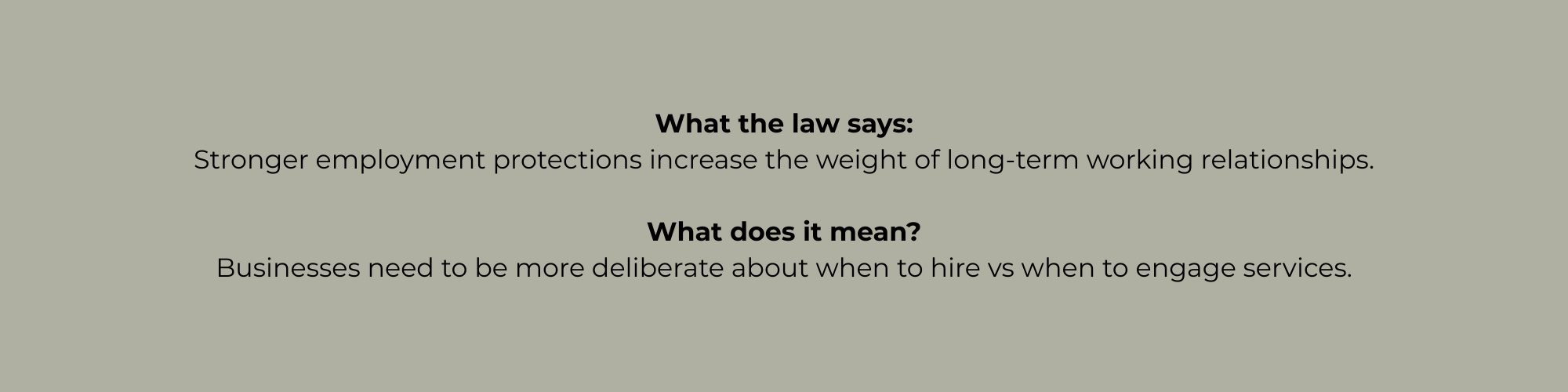
Recent and upcoming changes to UK employment law are shifting. Changing the balance between flexibility and protection. The intention behind it is clear: greater fairness and security for workers.
Although the reality for SMEs means hiring is becoming more structured, regulated and harder to keep flexible.
So… what’s actually changing?
The Employment Rights Act 2025 (rolling out through 2026–2027) is being described as the biggest overhaul of employment rights in a generation.
The direction of travel is clear:
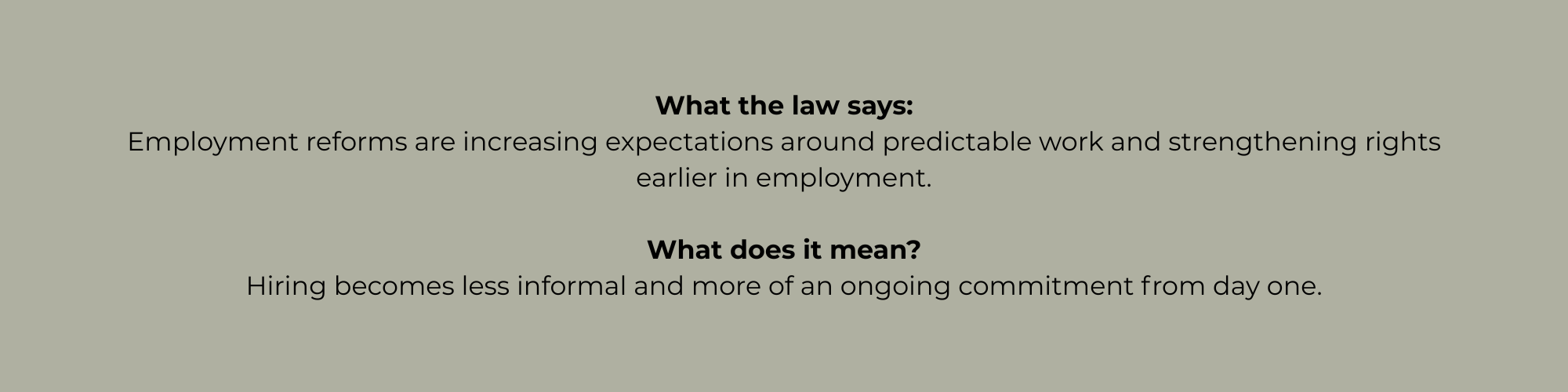
More protection for workers
More predictable hours
Stronger rights earlier in employment
Greater expectations around stability and security
For large organisations with HR teams and internal processes, this is manageable.
For small business owners juggling 57853645 things, it can feel heavy.
Hiring someone isn't about filling a gap, it’s about stepping into a defined, ongoing relationship with clearer expectations on both sides.
Some of the key themes:
Unfair dismissal protections kicking in earlier
Reforms to zero-hours arrangements (including rights to guaranteed hours after regular work patterns)
Stronger rights around sick pay, parental leave, notice periods and cancelled shifts
Greater scrutiny around informal working arrangements
In plain English?
Hiring is becoming more structured. More regulated. Less flexible.
Read more:
Plan to Make Work Pay and Employment Rights Act: timeline update - GOV.UK
Flexibility Is Becoming More Balanced
Let’s be honest.
A lot of small businesses have survived because of flexibility.
More work when it’s busy. Pull back when it’s quiet. Adjust quickly when the market wobbles.
That flexibility has often been essential to staying sustainable.
These reforms aren’t “anti-business” - they’re about protecting workers.
The practical effect is that the scaling of support up and down becomes harder. Which makes things tricky for businesses operating in uncertain markets.
It’s not just “let’s see how it goes.” It’s a defined, ongoing commitment.
And that’s where a lot of business owners are pausing.
Read more:

Why Outsourcing Is Becoming More Relevant
We’re already seeing a quiet shift.
More founders are asking:
“What support do I actually need - and how should it be structured?”
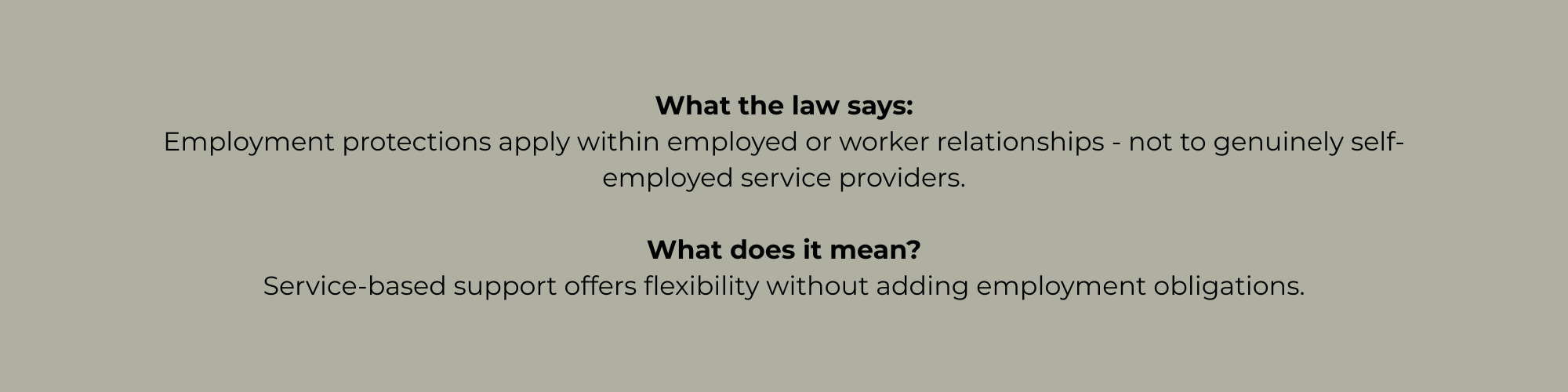
Instead of automatically moving towards employment, many are exploring service-based support (which, of course, is very exciting for us!).
Working with self-employed professionals allows businesses to:
Engage support around outcomes, not availability
Scale support without long-term obligation
Focus on delivery rather than employment structure
As employment starts to carry increasing commitments, outsourcing is a more aligned way to access skills without adding complexity.
Read more:
Let’s talk about “ongoing mutual obligations” (without making your brain hurt)
There’s a phrase in employment law called ongoing mutual obligations.
It basically means:
Is the client obliged to offer work?
Is the individual obliged to accept it?
If the honest answer to both is yes… that can start looking like employment.
Here’s a red-flag example:
A VA works Monday to Friday, 9–11
They’re expected to be available during those times
Work just “rolls on” week after week
They feel they can’t say no
Even if the contract says “self-employed”, that arrangement can start to look like employment in practice.
Now compare that to:
A defined service scope (e.g. inbox management, CRM updates, launch support)
Agreed outcomes or deliverables
No obligation to offer or accept future work
The VA works with multiple clients
Either party can step away in line with the contract
That’s a service relationship.
See the difference?
It’s not about hours being illegal. It’s about expectation and control.
But Structure Still Matters
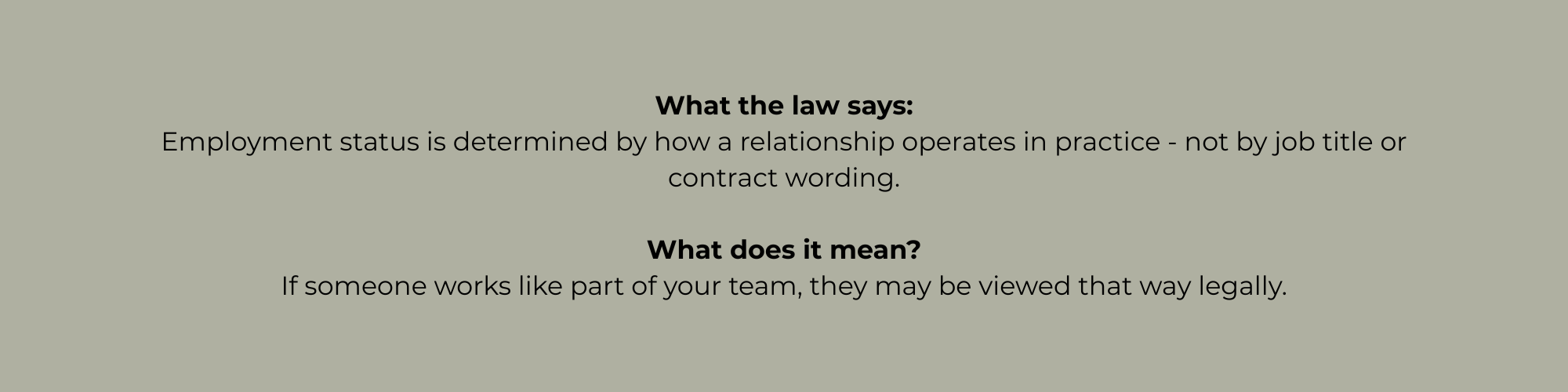
The distinction between employee, worker and self-employed status isn’t determined by title. It's more about how the relationship actually works.
You need to be able to understand the expectation of ongoing work, availability and how the work is directed.
You probably don’t need to rip everything up and start again.
But you do need to check:
Does the contract reflect how the relationship actually operates?
Are you selling outcomes… or availability?
Is there any language that implies guaranteed ongoing work?
Does the working reality drift from what was originally agreed?
This is something we’ve actively reviewed at TVC.
We’ve had honest team conversations about:
Do any client relationships feel like they just “run automatically”?
Are there expectations of constant availability?
Are we describing our work as “hours per week” instead of services delivered?
Has anything slowly drifted over time?
Because clarity protects everyone.
Read more:
A More Intentional Approach To Support
What’s emerging is a move towards being more deliberate about how support is built.
For many SMEs, that means thinking in terms of: Projects, Outcomes, Services
Rather than: Hours, Presence, Indefinite availability
We’re likely to see more blended support models. Combining employed team members with outsourced expertise.
How this changes the way we run things at TVC
So we’re being more intentional about:
Structuring support around services and outcomes
Regularly reviewing scope
Ensuring autonomy is protected
Making sure no arrangement quietly morphs into “employment without the label”
Read more:
Your rights as an agency worker: When you're an agency worker - GOV.UK
The Bottom Line
Employment law isn’t changing to make your life difficult.
It’s changing to create fairness and predictability.
But it does mean you can’t afford to be casual about how support is structured anymore.
Outsourcing isn’t a loophole. It’s not a workaround. And it’s definitely not just “cheaper staff.”
When done properly, it’s a service-led partnership.
And that distinction matters more than ever.
If you’re sat there thinking:
“I think I need support but I don’t want to get this wrong…”
I totally get it. Let’s look at it together and find a solution that works for everyone.
Feel free to reach out for a chat.
Read more:
FSB | UK employment law update 2026: The essential compliance guide for employers